Summary
- Axiom Space and Prada have unveiled the Liquid Cooling and Ventilation Garment (LCVG), the inner layer of the AxEMU spacesuit that astronauts will wear during NASA's Artemis IV mission on the lunar surface
- The LCVG circulates cold water through tubes across major muscle groups to manage metabolic heat during up to eight-hour spacewalks, featuring a fully redundant cooling circuit and a separate ventilation loop that delivers fresh oxygen across the astronaut's face while routing exhaled CO2 away to the life-support system's scrubber
- Prada contributed engineered knitting expertise and specialized fiber identification for repeated use across long-duration missions, with the garment developed through advanced 3D modeling techniques
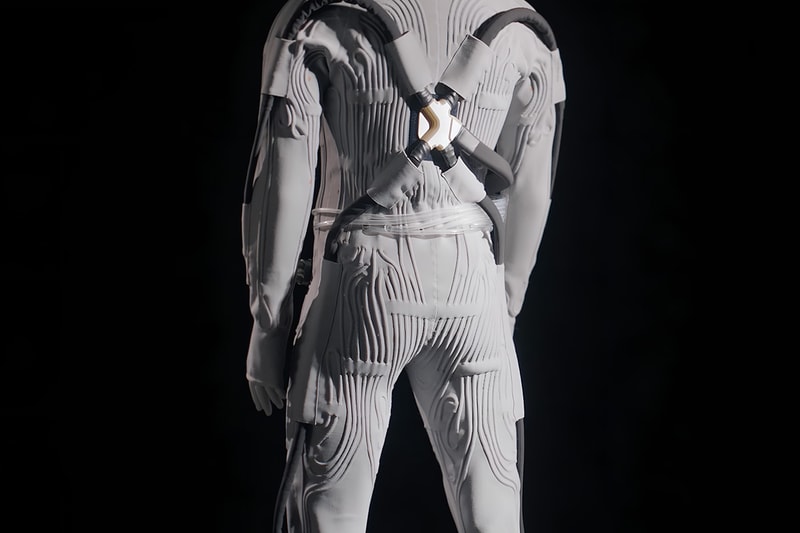
Axiom Space and Prada have unveiled the Liquid Cooling and Ventilation Garment, the innermost layer of the Axiom Extravehicular Mobility Unit spacesuit and the garment that will sit directly against an astronaut's body when humans return to the lunar surface for the first time in more than 50 years. Announced in New York City, the LCVG deepens a collaboration that began with the AxEMU's outer layer in 2024, moving from the suit's exterior protective shell to its most technically demanding zone.
The LCVG's primary function is thermal management, and the engineering required to deliver it during an eight-hour spacewalk is considerable. As crew members work on the lunar surface, their bodies generate significant metabolic heat. The garment circulates cold water through a network of tubes routed across the body's major muscle groups, absorbing that heat and carrying it away to the suit's portable life-support system, where it is expelled into space. Unlike previous cooling garments, the Axiom Space LCVG incorporates a fully redundant cooling circuit, meaning a backup system activates if the primary loop fails. On the lunar surface, with no possibility of a quick return to a pressurized environment, that redundancy is not a feature — it is a survival requirement.
The ventilation function operates as a parallel system. A separate loop of tubes delivers fresh oxygen continuously across the astronaut's face, washing away exhaled carbon dioxide in real time. That CO2 routes back through the life-support system's scrubber before oxygen recirculates through the garment again. The two systems — cooling and ventilation — run simultaneously across the full duration of the spacewalk, which can extend to eight hours.
Prada's contribution addresses the garment's material and construction challenges rather than its engineering architecture. The partnership drew on Prada's expertise in engineered knitting and advanced 3D modeling techniques to develop a garment that maintains cooling and ventilation performance while enhancing comfort across extended wear. Critically, Prada's knowledge of high-performance materials supported the identification and sourcing of specialized fibers that allow the garment to be worn repeatedly across long-duration missions. A cooling garment that degrades after limited use is a logistical liability in deep space; building one that holds its properties across repeated deployment required a material science approach that aerospace engineering does not typically develop independently.
"Every minute astronauts spend outside their vehicle, the LCVG is working to keep them safe," said Russell Ralston, Axiom Space Senior Vice President of Spacecraft Development. "It manages their thermal environment, supports their breathing, and does it all while they're pushing their bodies to the limit. The work we have done with Prada has taken that capability to a level we could not have achieved alone." The 2024 outer layer collaboration established that Prada's design and product development process could contribute meaningfully to aerospace engineering under extreme constraints. The LCVG demonstrates that the same is true at the garment's innermost layer, where the technical demands are entirely different and the margin for failure is the same.
The Prada x Axiom Space LCVG will be worn by astronauts during NASA's Artemis IV mission, which will return humans to the lunar surface for the first time in more than 50 years.
Click here to view full gallery at Hypebeast