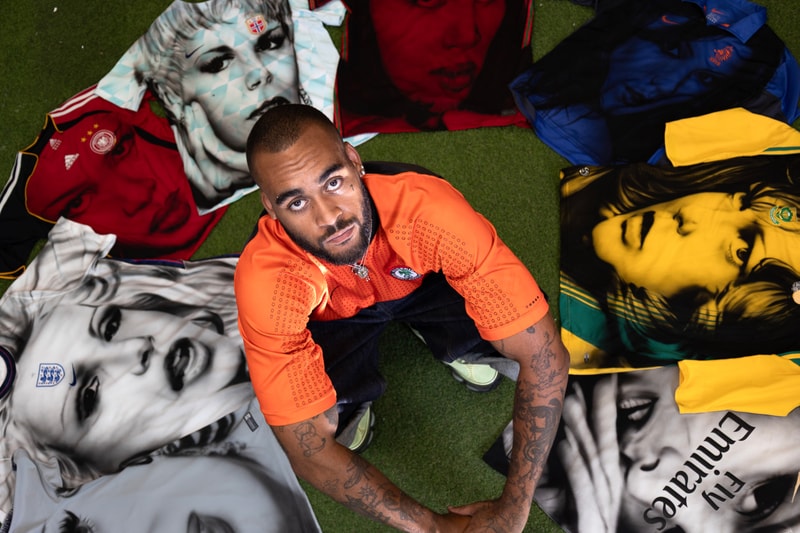
As the World Cup takes over New York City this summer, Hypebeast Cup is bringing its global tour to SoHo for its final stop. Running from June 26 through July 19, the month-long activation will transform the neighborhood into a hub for football culture, creative collaboration and community, hosting a rotating lineup of artists, designers, brands and events that explore the game's influence beyond the pitch.
Among those participating is London-based artist Mattia Guarnera, who will present a selection of original artworks painted directly onto football kits throughout the activation. While football serves as a recurring subject throughout his practice, Guarnera's work is rarely about the sport itself. Instead, he uses it as a lens to explore broader themes of identity, masculinity, competition and observation, often focusing on the quieter moments that exist outside the spectacle of the game.
Drawing inspiration from training footage, overlooked gestures and the emotional spaces between victory and defeat, Guarnera's paintings invite viewers to look beyond football's biggest moments and consider the narratives that unfold around them. His work often balances intimacy and distance, revealing just enough to pull viewers in while leaving room for interpretation.
Ahead of Hypebeast Cup New York, where his original hand-painted football kits will be on view from June 26 through July 19, we spoke with Guarnera about football as a visual language, the role of observation in his practice and what visitors can expect from his presentation.


"For me, sport just felt like a really natural language, something I already understood."
What first drew you to using sports imagery as a central part of your practice?
My connection to sports in my practice really started during my early career, when I was still at university. Around that time there was a lot of talk about democratising art, making it feel more accessible. For me, sport just felt like a really natural language, something I already understood. I started using it almost as a substitute for life in a way.
I think there are so many parallels between competing as an athlete and just life in general. Things like discipline, repetition, failure, and those small moments where everything briefly comes together.
How has your relationship with soccer influenced the way you think about storytelling and image-making?
Football has definitely shaped how I think about storytelling and image-making. It is not just about the big moments, it is everything around them. The buildup, the pauses, the mistakes, and the bits that seem small but actually carry a lot of weight.
I think that has naturally come into how I work. I am less interested in single images telling a full story, and more in fragments that build something over time. Like you are kind of piecing it together as you go.
Your work often focuses on moments outside the spotlight. What attracts you to those quieter scenes?
I have always been drawn to the alternative side of things. With football that shows up in all the stuff outside the main broadcast, like training clips, mistakes, or those random compilations you fall down a rabbit hole watching.
Those moments just feel more honest to me in a way. Outside of the spectacle, you see things that are not being performed. I have always been interested in that, both in sport and in life. I think there is a lot of beauty in what gets overlooked.
Themes of identity, masculinity and competition run throughout your work. What keeps you returning to those subjects?
I think it is mainly because they are close to my own experience. My work tends to reflect what I am going through at the time, so those themes come through quite naturally.
It is also about documenting that period of life. Being in my early twenties and growing as an artist has meant constantly shifting perspective, changing ideas, figuring things out as you go. So those themes of identity, masculinity, and competition just keep reappearing in different ways.


"I think of the paintings less as direct statements and more like situations I am setting up for someone else to look into."
Many of your paintings create a sense of distance or voyeurism. What role does observation play in your creative process?
Observation is a big part of it. I think of the paintings less as direct statements and more like situations I am setting up for someone else to look into.
I am always thinking about what is shown and what is slightly held back. That distance is intentional. I like there being a bit of mystery in the work, where not everything is immediately given to you.
How has your practice evolved since you first started exhibiting your work professionally?
It has definitely grown with me, both visually and in how I think about it. You gain more control and understanding over time, which is good, but you also lose a bit of that early naivety.
Right now I am actually interested in trying to loosen things again. Finding that balance between control and instinct. Knowing what you are doing, but still letting things feel open and not overworked.
What interested you about collaborating with Hypebeast Cup, and what can visitors expect from your activation?
Hypebeast was always something I grew up around culturally. It felt like this digital space that defined a certain idea of "cool" at the time. So being part of it now, and bringing it into a physical space, is what I am most excited about.
I think it is also about the mix of people coming into contact with the work. Different audiences, different contexts, all in one space. That is something I really value.
What projects or ideas are you most excited to explore next?
Right now I have been quite focused on the World Cup side of things, so that has taken most of my attention. I have been enjoying it, but I am also looking forward to stepping back into a more inward space afterwards.
Just focusing back on myself a bit more, and where the work is coming from internally. That kind of back and forth is important for me.
Click here to view full gallery at Hypebeast