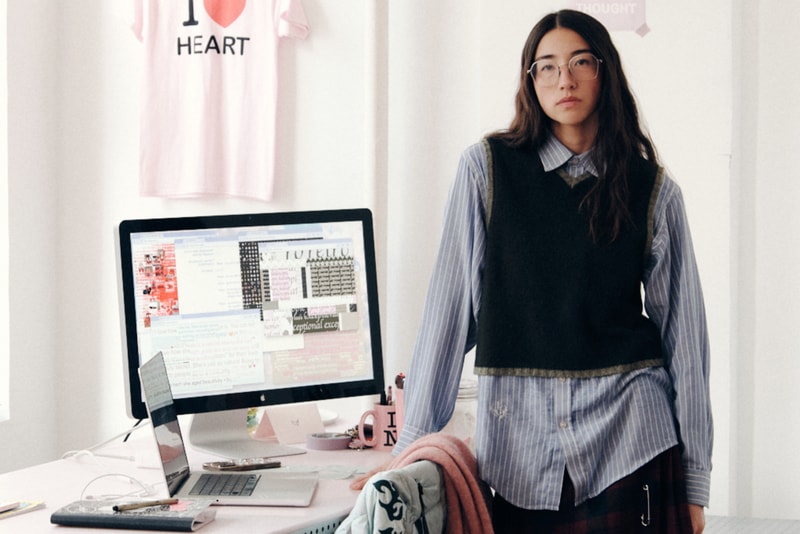
Maya Man creates with the screen-fed close to heart. The internet is the medium and message for the New York-based artist, whose practice unpacks the strange choreography of life online and the algorithms that make us.
“The idea of ‘being yourself’ was always difficult for me to grasp,” she tells us. Effervescent and coquettish in appearance, Man’s work critiques the demand for self-curation and optimization through its very tools: Depop surfing, aspirational texts, TikTok dances, “day in my life” vlogs. Rather than trying to close the gaps between performance and authenticity, she proposes a way to live within them.
Her desktop, despite working primarily in code, takes up only a modest corner of her sunny SoHo studio. Also home to her curatorial project, Heart, the rest of the space brims with teen fashion magazines, plush dolls, influencer ephemera and pastel-hued posters of algorithmically-generated affirmations. “Mind, body, soul…hotter,” hangs near the entrance. Another reads, “Be Disrespectful to One Another.” Racks of sequined dance costumes sit upright in the back.
We caught Man in the midst of a major bi-coastal moment, with StarBound up at SOOT in Los Angeles and StarPower, opening later this month at New York’s bitforms gallery. Both exhibitions center her latest project, “StarQuest,” described as her most “personal” work yet. Drawing on her own experience as a competitive dancer, and love for the reality series Dance Moms, the sculpture-film showcase probes into the many ways we rehearse, stage and aestheticize artifice.
For this edition of our Visits series, Man sat down with Hypeart to discuss digital girlhood, the power of posting and what it means to perform when the world is your stage.

"When people hear ‘digital art,’ they have a singular idea of what that looks like. My desire is for that to be really pushed and pried open."
What roads led you to becoming an artist?
When I was younger, I created a collage of my identity based on what I saw online. A lot of my work today peels back those layers of self-performance to understand how it affects the way people develop a sense of persona.
In college, I studied computer science and media studies, and as long as I’ve been interested in math, I’ve been fascinated with how I interact with technology, social media in particular. Pairing those disciplines was really generative, but I didn’t fully understand that I wanted to do this until I moved to New York and met other artists. I saw that there was room in contemporary art to make work that was heavily focused on the internet.
You also had a stint in corporate tech. If not art, what other paths did you have in mind?
After graduating, I worked as a Creative Technologist at the Google Creative Lab. I wanted stability, I wanted a job, but I also wanted to be able to explore code as an artistic medium. I was there for three years, and learned so much, but over time, I realized that I wanted to be make stranger, critical projects that were wholly mine, so I left Google to get my MFA.
Can you describe your experience exhibiting at Zero 10 at Art Basel Miami?
When people hear ‘digital art,’ they have a singular idea of what that looks like. My desire is for that to be really pushed and pried open. Zero 10 introduced new people to what was happening in that scene in a really exciting way.
There's something irreplaceable about physically gathering to talk about art. There's a lot of exciting work being made, but it's not being shown because a gallery, for example, doesn't know how to show and sell it. I hope this was a first crack open, and we can continue to showcase the variety of practices that digital art has to offer.


"The internet, to me, is a feminine space... Women and young girls have always been the best at using social media platforms, so when we talk about digital art, it's important to include gender and performance in that conversation."
Speaking of physical space, can you describe where we are? What is Heart?
Heart is a curatorial project I started in 2024. It grew out of a series of fortunate events: I’d been wanting to platform artists in my orbit, engaging with the internet, software and pop culture — those three categories encapsulate what I'm interested in as an artist and curator. At the same time, I started working out of this studio, which was much larger than I needed, so I wanted to use it to bring people together in-person.
The internet, to me, is a feminine space, and what Heart presents is really trying to wrap around that. Women and young girls have always been the best at using social media platforms, so when we talk about digital art, it's important to include gender and performance in that conversation.
You were also early to the Addison Rae train. She was the subject of your piece in Heart’s first Sacred Screenshots show.
I’ve been interested in her since the early days of TikTok. She’s so skilled at posting on the internet; I talked about this in my performance, “StarQuest.” She’s been trained for this. She grew up as a competition dancer, like me, so I understand what it means to be engineered as a performer, to be appealing to a wide audience, but also be very feminine and sweet.
How does your experience as a competitive dancer help you understand how we perform online? As an artist working with AI, what does it mean to “coach” pixels to do what you want?
“StarQuest” was the most psychologically challenging work I've ever made. In the piece, there’s a coach that says, ‘Are you going to get out there and choke? Or are you going to be exceptional?’ It echoed how I hold myself to this impossible standard, which is something I've carried over from being a dancer.
Part of why I make work, especially this piece, is that I feel like I'm always on stage and I've never been able to escape that. I’m older now, and reflecting on the years that I've spent online, I have a really different relationship to the internet. Making the piece, shifting roles from dancer to coach, really solidified that.


That’s something so unique about digital work: you can have multiple ‘true’ ways of seeing it...
While wrestling with your own relationship to online performance, Instagram has both tilted towards professionalism. How has this relationship changed since you started making work about them?
My online presence now is almost purely professional, but I really love having a direct line to my audience. It’s something that artists didn't always have. Before the internet, you needed a gallery or institution to contextualize your work, so I like being able to communicate my work to others. Posting as an artist has been so powerful for me.
Your work spans websites, physical installations, browser-based extensions and AI videos. How do you choose the format for each piece?
I use custom software in most of my work, specifically JavaScript. I like the level of control it gives me. Because so much of what I do deals with the internet, I like playing in that arena — the browser. It’s lost popularity, but making websites used to be the main way of participating on the internet. Social media has made uploading content much easier than coding, but I’ve really maintained a closeness with those tools because that’s the core of creating online.
There’s also a special word-of-mouth quality to sharing websites, rather than relying on an algorithm to feed it to you.
I agree. You can view my websites from your laptop at home, and that’s a very true experience of viewing my work. It’s not documentation or an approximation of it. With “(The Angels Wanna Wear My) Red Shoes” at Art Basel, we had these gorgeous, bespoke screens by Layer that echoed the square format of Depop photos. That’s something so unique about digital work: you can have multiple ‘true’ ways of seeing it and I really appreciate that fluidity.


With the internet, AI and LLMs, imagery has gotten noisier, but artists are able to cut through that to say something specific."
Your videos often play with the awkwardness and aesthetics of “slop.” How does your medium interact with the message of your work?
I have a lot of fears about how artificial intelligence will broadly affect labor, but feel unconcerned about how “slop” will impact fine art. A friend of mine, Lucas, talked about it in a recent essay: anyone can take photos on their phone, but not everyone is a photographer. A photo of where you parked your car is an image, but that doesn’t make it art. People can make crazy videos, but art can continue to be protective. With the internet, AI and LLMs, imagery has gotten noisier, but artists are able to cut through that to say something specific.
It’s also challenging for artists to decipher why they’re employing these technologies. For “StarQuest,” I had to really sit with those questions: Why am I using AI? Is it necessary to make the work the best it could be? Because “StarQuest” is about the training process and striving to be an image of perfection, AI and reality television were perfect analogies to explore what’s real and what’s fake.
The scenes are modeled off an existing show, but the characters don’t exist. Yet as I watched them back, it had an emotional effect on me. It freaked me out. You can manipulate affect through the visual content. It’s a powerful position for anyone to be in.


"You can manipulate affect through the visual content. It’s a powerful position for anyone to be in."
Who are some figures that have been influential to your practice?
Cory Arcangel is an artist who’s always been able to touch all the universes of Heart in a way that’s really poetic and beautiful. There’s artists who aren’t working digitally, but have a collage-like sensibility in their work: Maggie Lee, Ingrid Lu and Tess Manhattan. And Lynn Hershman Leeson, Anne Hirsch, Molly Soda and Petra Cortright — artists who are thinking about the performance of femininity online.
I've been thinking a lot about fan culture recently. The unconditional, worship-y enthusiasm fans have. I've always really liked that attitude and it’s a little antithetical to the art culture mindset.

I'm interested in this fluidity of girlhood because we maintain it our whole lives. No one really knows who they are, and there’s something about this concept that’s emblematic of that."
How would you describe online girlhood for that haven’t explicitly experienced it?
From an early age, women are conditioned to watch themselves from a third person perspective, and that experience is totally amplified and exasperated online. Young girls are confronted with this always-on condition of hyper-fixating on performance. At the same time, though, being able to choose what you identify with is really beautiful. Everyone curates their own sense of self. It's complicated, I haven't figured it out, but that's why I like making work about it.
Youth and femininity are frustrating categories to make work about because the experiences of young girls are generally disregarded. It’s an exercise in giving weight to an important identity.
One of my favorite books about this is Girlhood in the Plastic Image. Heather Warren Crow does such a nice job of laying out what she views as girlhood: a time where you're morphing in some way, versus the idea of womanhood, which is more fixed. I'm interested in this fluidity of girlhood because we maintain it our whole lives. No one really knows who they are, and there’s something about this concept that’s emblematic of that.
In your career so far, you’ve contributed so much to this concept. As an artist, where do you see yourself headed?
I want to work on projects that can manifest into world-building projects. As a younger artist, especially one who makes work on the internet, I’ve always been very scrappy and can often create with just my own computer.
I have a really intense fear that the most interesting digital art and artists working today are getting buried in the larger, often market-driven narrative. Even though it’s such a vast discipline, there isn’t much space given to it. I want to make sure that smart, critical work about internet culture is well archived and continues to be shown through vehicles like Heart.
There are a lot of problems with culture and art right now, but this is what gives me the most fulfillment. When there's so much moving art out there, I let myself be excited because, otherwise, what is there to live for?
Portraits by Nayquan Shuler for Hypeart. Images of artworks courtesy of the artist.
